

A Twitter marketing strategy gives every post, reply, and campaign a clear business purpose. On X, formerly Twitter, that means identifying your audience, sharing useful content, joining relevant conversations, and measuring what happens next. This guide explains how to use Twitter for business through 12 practical steps covering profile optimization, content planning, engagement, advertising, and analytics.
What Is a Twitter Marketing Strategy?
Twitter marketing strategy is an approach that uses X for accomplishing business objectives through a combination of your audience, voice, content, engagement, posting frequency, paid promotions, and analytics.
The development of a Twitter marketing strategy begins with identifying an objective. They could include traffic to your website, leads generated, product awareness, customer support, and community engagement. After that, you will be making a decision on the type of content, target audience, posting frequency, and what success measures would be used.
For American brands, Twitter marketing strategy is still relevant. The number of users reached by advertising services provided by X was 99 million as of late 2025 in the United States, which corresponds to 34.3% of adults in the reported advertising audience of the country. These statistics are the estimates of the audience reached by ads, not the number of monthly active users.
Why Twitter (X) Marketing Still Matters in 2026
X offers a valuable strength in that it is quick. News, product announcements, sports, debates in industries, customer queries, and culture can be developed within a matter of minutes. The importance of this platform for any company interested in being part of the discussion lies herein.
For businesses, the practical question is whether their target customers actively participate on X. Look for relevant industry discussions, customer questions, and conversations around competing products. These signals can help you decide whether the platform deserves a place in your marketing plan.
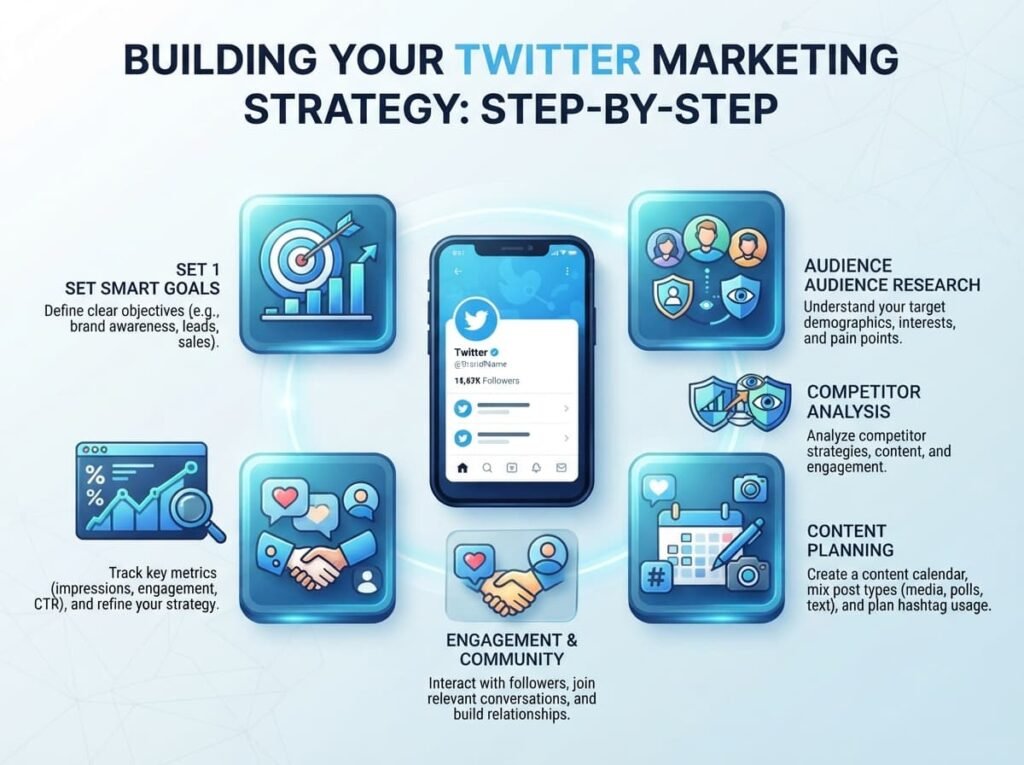
How to Build a Twitter Marketing Strategy: Step-by-Step
1. Define Clear, Measurable Goals
Set just up to three objectives to start out. Try not to pick goals that are kind of vague or hard to count, like “gain recognition.” Instead, go for ones you can put numbers on, like raising quality traffic by 15 percent, generating 30 leads every month, or increasing engagement over a 90 day stretch.
The chosen objective will determine your content type. If traffic is your objective, you need relevant backlinks and calls to action. If you choose customer service as an objective, quick responses will be important. Brand awareness requires interesting commentary and educational material.
2. Audit Your Current Twitter/X Account
Before making changes to your content, take a look at what you are doing well currently. Look at your following growth, impressions, engagement rate, link clicks, visits to your profile, posting frequency, and most successful posts.
Can you recognize any trends? Have you seen better success with an opinionated tweet compared to a promotional graphic? Have comments driven more profile visits than posted tweets? Is there a certain subject matter that has brought the right audience?
Export your current metrics so you can use them as a base to compare against in the future when assessing your Twitter growth strategy.
3. Know Your Audience and Build Buyer Personas
“Don’t write for everybody.” Creating a good Twitter growth strategy begins by creating a defined target audience. Decide who you want to talk to. This may be startup owners, marketing managers, or operations executives in the case of a software firm based in the U.S. In the case of a local services firm, it may be homeowners in certain cities.
Analyze the conversations going on among the target audience. Look at the comments under competitors’ posts, and observe industry conversations on Twitter. It is necessary for understanding language and problems, not collecting demographics. This would help in developing a Twitter marketing strategy.
A helpful Twitter persona could state, “Small-business owner in the U.S., age 30-50, busy with little time, looking for marketing tips and hating jargon. Reads X for industry news.”
4. Establish a Consistent Brand Voice
The voice that you use must be unique even when you do not have the logo. Consider the voice that you would like your brand to use. Would it be factual, functional, humorous, technical, warm, or authoritative? Once this is done, create the rules on how to deal with vocabulary, humor, punctuation, and criticism.
This is when Twitter branding is not limited to profile styling alone, and Twitter marketing strategy is distinct. In the case of a cybersecurity firm, you can avoid fear-mongering tactics and use simple English instead. A fitness brand can have a lively and motivational tone.
5. Optimize Your Profile
One of the first pages that visitors will check out when they come from an article or other piece of content of yours will be your profile page. Give people a reason to follow you by helping them understand who you are.
Some things that you can do include:
- Using a profile picture that is easily recognized.
- Select an appropriate header image.
- Have a short bio about yourself that explains your value.
- Include your website or landing page.
- Pin a post about your most valuable resource or offer.
- Make sure that your name and visual branding is consistent across platforms.
Great Twitter branding makes your account credible but not too polished or corporate. It will give your Twitter marketing strategy a consistent visual element.
6. Analyze Your Competitors
Choose five to ten companies whose target audience is similar to yours. Check out their posting patterns, topics, styles, interaction, hooks, and responses.
If all competitors post nothing but product announcements, you could post useful tutorials. If your competitors never respond to any questions from users, you can be known as a good responder. If all use similar general advice, you can give unique examples and statistics.
This strategy will help in your Twitter marketing because uniqueness will make people remember you. This is one of the easiest ways of Twitter marketing to try.
7. Build a Content Calendar and Post Consistently
Content Calendar allows you to keep your account active without having to come up with something new every day. You should start with a feasible schedule that you will be able to uphold.
One of these could involve education-based content, opinions, customer stories, product information, questions, videos, polls, and links. An 80/20 split could be a good way to begin, where 80% will be either informative or entertaining content, and 20% will be promotional content.
For instance, for a B2B business, it could be a weekly combination of one thread on education, several insights, a customer experience story, a product-based post, and replies.
8. Use Hashtags and Trends Strategically
Though hashtags may aid in organizing or finding relevant conversations, the rule “the more the merrier” does not work here; use only those hashtags which make sense.
A branded hashtag may be used for uniting all the content created for the marketing campaign. A niche hashtag may be used to join an industry-specific discussion. And a popular hashtag may broaden the relevance of the post, provided it has something to do with the business itself.
Do not insert irrelevant hashtags, because it may spoil the reputation of the brand. Check out whether someone interested in that topic may need that post.
9. Post at the Right Times
There is no perfect posting time. Your audience will act differently than the other company’s audience.
Begin with testing the window in U.S. time zones. Afterward, analyze your results and discover what times are best for your followers.
Always test one variable at a time. You will not be able to determine what influenced the result when you change the posting time, topic, and hook all at once.
10. Engage With Your Audience in Real Time
Posting is part of the battle; the other part is the discussion.
Answer questions in earnest. These personal touches will help with Twitter growth. Appreciate people who give valuable feedback. Ask questions back. Engage in industry-related discussions. Take a poll if you require an instant response from the audience. Respond in a sincere and human manner whenever your brand is mentioned by a customer.
Engaging in real-time conversations helps in growing your Twitter account since people will know that there is a live team managing the Twitter handle. It also helps in creating a Twitter brand as every single response of yours becomes the image of the organization.
There is no need to automate everything. Scheduling tweets will make you save your time.
11. Consider Twitter/X Advertising
Promotion through spending can come into the picture when one is able to identify that a particular message is working for him/her in their Twitter marketing strategies. Based on the arrangement of the campaign and products available, ads can be promoted to specific audiences with an objective in mind.
Go for paid campaigns only if there is a good reason behind spending money. Some reasons can include a high-quality guide, registration drives, new product launches, etc.
12. Track Analytics and Refine Your Strategy
Track impressions, engagement rate, follower growth, and link clicks using the metrics available in your account or reporting tool. Match these metrics to your goals: impressions help assess visibility, while website visits and qualified inquiries help assess business impact.
Review results weekly and compare monthly trends. Use UTM-tagged links to identify campaign traffic in your website analytics. Repeat topics that attract relevant interest, improve weaker posts, and test one change at a time.
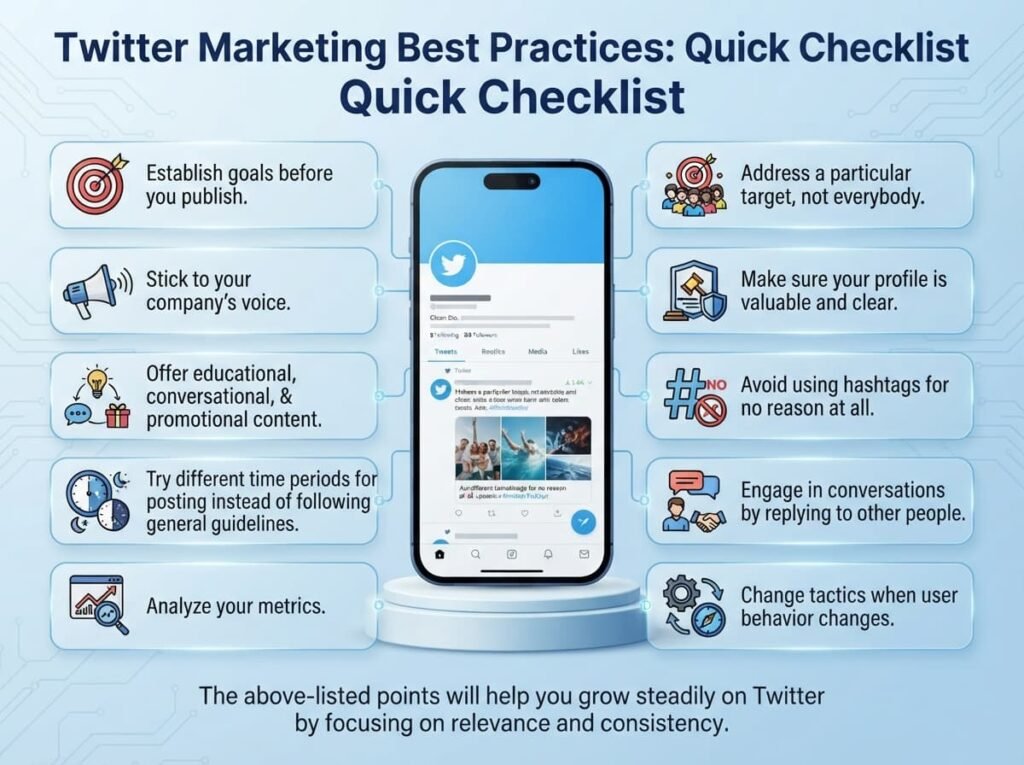
Twitter Marketing Best Practices: Quick Checklist
- Establish goals before you publish.
- Address a particular target, not everybody.
- Stick to your company’s voice.
- Make sure your profile is valuable and clear.
- Educational, conversational, & promotional content should be offered.
- Avoid using hashtags for no reason at all.
- Try different time periods for posting instead of following general guidelines.
- Engage in conversations by replying to other people.
- Analyze your metrics.
- Change tactics when user behavior changes.
The above-listed points will help you grow steadily on Twitter since they pay attention to relevance and consistency instead of using quick fixes. Besides, it keeps your Twitter marketing strategy on track.
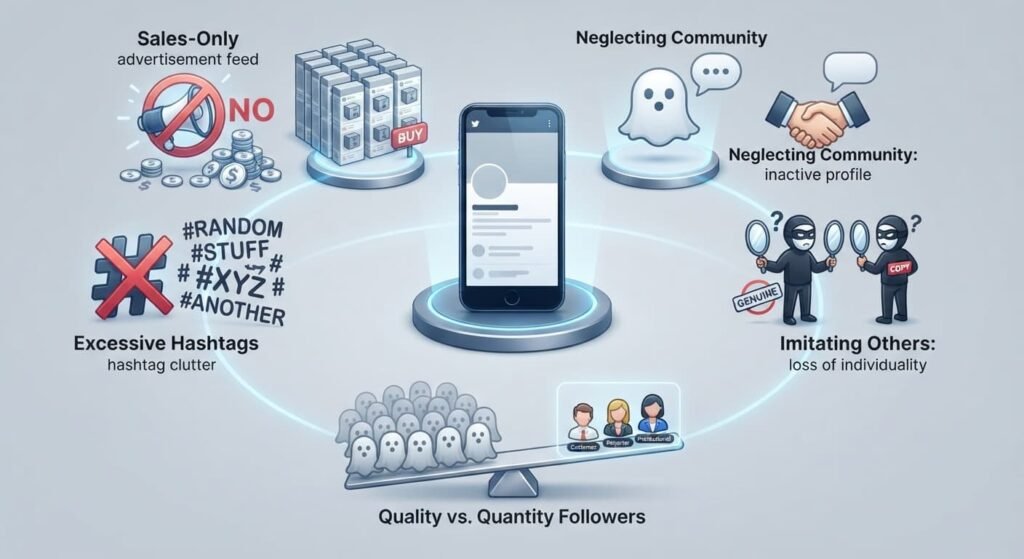
Common Twitter Marketing Mistakes to Avoid
The first error is publishing posts only when you have something to sell on Twitter. This will make your account appear more like an advertisement than anything else.
Secondly, do not neglect communication with people. You can be publishing amazing posts, but if you do not communicate with your community, you will appear inactive.
The use of excessive hashtags is another mistake. Adding hashtags that are irrelevant to your post will not magically increase your reach. Imitating others is a big no-no too, as you lose your individuality.
Finally, do not get obsessed with the number of your followers if you do not care about their quality. Proper Twitter branding should bring you a relevant community, not just any community. For example, ten thousand followers who do not care at all about what you offer are not better than several customers, prospects, journalists, and other professionals.
Frequently Asked Questions
What is a Twitter marketing strategy?
This is kind of an organized way to use X to hit different business aims, like building awareness, boosting traffic, producing leads, and so on. It also covers doing audience research, making content. Then there is branding engagement advertising and, of course measuring results, so you can tell what worked.
What should I do to get more followers on Twitter using a marketing plan?
Post something useful, be clear about who you are, keep up with what’s going on in the same field as yours, and provide a genuine reason for following you. In fact, it’s better to concentrate on relevance rather than buying followers.
Does Twitter have a marketing strategy businesses should follow?
This does not mean that there is one set recipe that works for all companies. Goals should be set; the audience should be identified; valuable content should be created and engaged with, experimented on, and tested.
How much does Twitter marketing cost?
Organic posting can be accomplished with no advertising budget but will take up time and effort. In the case of paid promotion, the price may differ depending on the goals, the target audience, creative elements used, and bidding rules. Establish a test budget for your desired outcome.
Is Twitter/X still effective for marketing in 2026?
Yes, and for those companies that have an audience there who can take part in real-time discussion. Yet, the effectiveness always depends on your industry and approach.
Conclusion: Build a Strategy You Can Improve
The ideal Twitter marketing strategy does not necessarily revolve around publishing more because of the sheer necessity to publish more often. The perfect approach would include the following: reaching out to the target audience, publishing useful content, joining in conversations, and subsequently evaluating the outcomes of this process. One needs to define goals, develop personal style, test content, and analyze its performance.
Start with one measurable goal, follow a manageable posting schedule, and use your results to improve the next month’s strategy.