
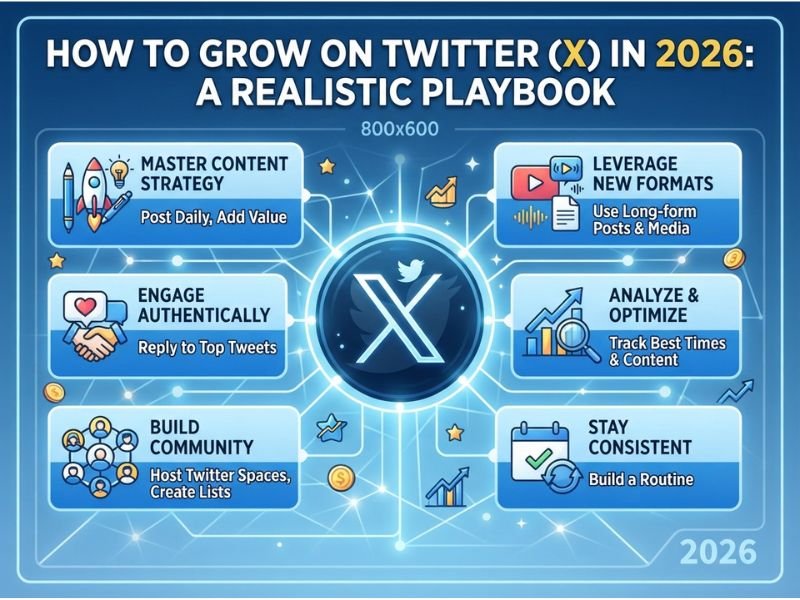
Grow on Twitter involves more than getting one viral tweet; it includes creating an actionable strategy. X has evolved a lot compared to the early version of Twitter, and it employs numerous parameters to recommend content. X claims that there is no one-size-fits-all parameter that carries a constant weight; the recommendation algorithms take into account several things like accounts and Topics you follow, likes, replies, retweets, shared links, media consumption, and even engagement within the user’s circle.
It makes sense, then, why some of the old strategies won’t work anymore. Just tweeting randomly, stuffing hashtags, and hoping for the best won’t cut it. In this guide, I’ll be talking about how to grow on Twitter in 2026 through an actionable strategy for beginners and creators. You will get to understand the recommendation algorithm, optimize your profile, know what to post, how to create Twitter engagement, and turn those conversations into Twitter followers.
How the X Algorithm Actually Ranks Your Posts in 2026
The way to be successful on Twitter is by knowing what X is aiming at. The network aims to present to its users posts that will be relevant, engaging, healthy, and provide a good experience.
At the moment, X calls its recommendations “a mixture of different signals” rather than one single ranking factor. The For You feature of X uses interactions and network behavior to find relevant posts, even those from people that you don’t follow.
Early Engagement Velocity Matters
The first few minutes after publishing can help you find out how your content is performing, but do not consider the first 30–60 minutes as an algorithmic deadline.
On the contrary, use these minutes to stay reachable. Answer legitimate questions and continue the conversation. In case your tweet starts gaining traction, provide people with a motive to discuss.
Good Twitter engagement right after publishing also helps to know whether you have created a compelling hook or not. A tweet that gets replies deserves more attention than the one with just views.
Who Engages With You Matters
But not all interaction has the same value toward achieving your goals. Interaction from someone who constantly talks about your field is worth more in terms of creating a community than likes at random.
X has many such signals, social and behavioral, in its recommendation systems. Take its account recommendation system; it relies on several signals associated with the probability of a user following and interacting with an account.
So, the goal should be to attract the right people and not simply build up Twitter followers.
What About External Links?
The problem is that many creators are told X will always block posts with any links. This is not true.
Link posts do serve a purpose, and traffic should be a priority in many situations. But if you post a “Read my article” message, your audience won’t see much incentive to pause their scrolling.
Instead, start with some valuable content in the post itself. It could be an interesting fact, a lesson, a statistic, or a quote. Then add the link to it if people wish to know more.
Set Up Your Profile to Convert Visitors Into Followers
Before attempting to grow on Twitter, you need to ensure that your profile is capable of turning attention into followers.
Suppose a user discovers one of your tweets. They tap your profile. Within seconds, they determine whether you are worthy of their follow.
Your profile should address these three questions:
- Who are you?
- What are you all about?
- Why should people follow you?
Photo and Banner
Make sure to choose a recognizable picture that represents your profile since you will have to be identified easily even on your small-screen mobile phone.
The banner must support your specialization. You can either state what you do, who your target audience is, or even what kind of content is offered.
Write a Useful Bio
A good bio conveys a few reasons as to why others would want to follow that profile.
You could inform someone. You could inspire them. You could entertain them. You could enlighten them. Or you could help them understand an issue they are facing.
Example:
“SEO Tips For Small Businesses | Content Strategy & Search Experiments”
It informs the visitor about what is offered without being too sales-oriented.
Use a Strong Pinned Post
Your pinned post is the introduction to your profile. Use it to introduce the best guide, your best opinion, helpful resources, or your post about your work.
Remember that you do not have to keep changing it daily. Just check your profile regularly and change it if you see that you should.
Make Your Handle Easy to Remember
Your handle should be easy to remember. In addition, there must be no additional digits within it if it is at all possible, and it has to be spelt straightforwardly. Secondly, the profile link is capable of directing the visitor somewhere else, for example to your website, newsletter, portfolio, and so on.
Starting From Zero: How to Grow With No Followers
The knowledge about techniques of getting followers on X becomes clear if you understand that posting is not the only one way to do it.
Being new, you have no visibility – it is normal.
Use a reply-first strategy. Spend 10-15 minutes watching the discussions in your sphere before creating your post.
Find accounts with about 1,000-10,000 followers. These accounts usually have engaged communities but are not very large to ignore a clever reply.
Don’t write something like “Great post!” Instead, give a piece of valuable information.
Here are examples:
Original post: “Most small businesses fail in creating consistent content.”
Weak reply: “So true!”
Smart reply: “It becomes easier when businesses use three different formats instead of making everything from scratch.”
The second comment gives useful information to the reader, and it is obvious that he/she will definitely click on the link to your profile.
X also offers searching for relevant threads. It uses a lot of factors to determine its results, including engagement, relevance, author signals, media interactions, post age, and many more.
Use this function and search in your sphere, applying filters to find relevant threads.
Good starting numbers might be the following:
- 10 thoughtful replies per day
- 1 original post per day
- 2 deep threads per week
- 15-20 minutes of active discussion
That is the technique for grow on Twitter.
What to Actually Post: Content Format Breakdown
The key to growing your Twitter account is not sticking to just one format. Experiment with various formats until you find out which ones work best.
Video
Video content can be a great way to increase your account’s personality and memorability.
Try making face-to-camera explainers, screen-captured videos, tutorial videos, reactions, and behind-the-scenes video content.
Make sure that you start with a good hook and tell people what they are about to learn.
Don’t overproduce everything. Good audio quality, decent lighting, and information will do the job.
Threads
Threads work great when you need to elaborate on an idea.
Thread is ideal for:
- Step-by-step tutorials
- Case studies
- Lessons learned from a project
- Contrarian ideas
- Mistakes and fixes
- Industry breakdown
The first tweet should grab the attention of people and make them read further. Every next tweet should add something to the overall idea.
Single Posts
Single threads are perfect for making quick observations.
This could be sharing an observation, asking a question, explaining an unexpected outcome, or offering one tip.
Structure:
Observation + context + learning point
Example:
“Posting more did not improve my poor content. However, changing the first sentence worked.”
Now elaborate on how you made that change and your findings.
Follow the 80/20 Principle
It is best to start with the concept of 80/20.
Basically, 80% of your postings should contain some level of entertainment or an interesting factor. Promotional content should come in at 20%.
It does not have to mean that all of your posts will be purely altruistic in nature, but rather that you will be adding more value to your followers’ time than pushing a sales pitch.
For more suggestions, TalkSocially’s social media content strategy guide will show you the ropes on creating and managing content successfully.
A Realistic Weekly Posting Routine
There is no need for you to spend all your time on X to achieve anything worthwhile.
If you have some 30 minutes in a day, then use this method:
| Activity | Weekly Target |
| Original posts | 5–7 |
| Threads | 1–2 |
| Thoughtful replies | 50+ |
| Video posts | 2–3 |
| Profile review | 1 |
If you have 1-2 hours per day, focus on improving the quality of the time that you spend.
A better approach would involve posting 7-10 unique tweets, 2 threads, 3-5 videos, and some interesting conversations each day.
These specific figures are not important here. What is vital is being consistent.
Do not make up for a missed day by creating 15 tweets the very next morning.
Being consistent will help you succeed on Twitter since there will be more chances to understand your audience.
Twitter Engagement and Relationship Building
The number of engagements on Twitter is not a vanity metric.
A reply may lead to an interaction. An interaction may turn out to be a relationship. A relationship could develop into a client, partner, subscriber, or follower.
The first step is engagement with individuals that fascinate you.
If someone bigger in your field shares something valuable, share a view or two without copying their words or trying to blow their mind.
And yes, you can DM people if there’s a real reason to go on with the conversation. Don’t send a sales pitch right away to each new connection you make.
Even if engagement pods and fake interaction will give you some numbers, they won’t form a healthy audience. People who are interested in your material can help you more, as it really matters to them.
With time, engagement will let you build a community, which can help promote your content to other audiences.
Track What’s Working
To grow on Twitter, you have to keep track of what takes place after your tweets go out.
Do not limit yourself to impressions alone.
Consider:
- Replies
- Reposts
- Likes
- Profile visits
- Clicks
- Followers gained
- Video views
- Thread completion
- Engagement rate
- And then analyze different formats.
Perhaps your videos bring in the most profile visits; maybe threads attract the most followers; and short opinion tweets may bring the most replies.
Do not guess; check your metrics.
X employs various engagement, relevance, author, and content metrics in its search and recommendations algorithm, which is why you should consider several metrics and not just focus on one.
Analyze your metrics every month; stick with what works, improve on what does not, and kill off what does not work.
You can also utilize TalkSocially’s social media marketing tools guide when you require some tips in scheduling, analysis, and content management.
How to Grow on Twitter Faster Without Chasing Hacks
To get bigger on Twitter faster, start by thinking about the aspects that you can actually influence.
There is no way that you can control the viral status of just one post. But there is no stopping you from publishing high-quality content regularly.
There is no way you can control who finds out about you. But there is no stopping you from crafting a clear explanation of yourself on your profile.
There is no way you can control all the signals that get sent for recommendations. But there is no stopping you from publishing high-quality content.
You also cannot force others into being Twitter followers. But nothing is stopping you from making things easy for them when it comes to following you on Twitter by focusing on a specific niche.
This is how you should be growing in 7 simple steps:
Research → Create → Publish → Engage → Measure → Improve → Repeat
Do this for thirty days straight before analyzing your strategy.
Remember that X’s recommendation system can change. The open-source X recommendation repository provides technical context for its For You feed, but it should not be treated as a guaranteed growth formula.
In short, the best approach would be building real relationships.
FAQs
Q1. How can I grow on Twitter (X) from zero followers?
A1. Choose a clear niche, explain who your content helps in your bio, and pin a useful introductory post. Publish original content and contribute thoughtful replies to relevant conversations. Review which topics attract meaningful engagement and build on them.
Q2. How often should I post on Twitter to grow?
A2. Start with a manageable routine, such as one original post a day and regular thoughtful replies. Add threads or videos when you have something useful to share. Treat this as an experiment, not a fixed algorithm requirement, and adjust based on your results.
Q3. What should I post to attract relevant followers?
A3. Share practical tips, original observations, step-by-step threads, project lessons, and short explanatory videos. Keep your topics relevant to a specific audience and give people a clear reason to follow for more.
Q4. How long does it take to grow a Twitter account?
A4. There is no guaranteed timeline or follower target. Results depend on your niche, content, existing network, and consistency. Use an initial 30-day period to test your routine and review progress rather than expecting a fixed number of followers.
Q5. Which metrics should I track for Twitter growth?
A5. Track replies, reposts, profile visits, link clicks, and follower growth where those metrics are available. Compare similar posts and time periods, and prioritize results that support your goals rather than impressions alone.
Q6. Should I buy followers or use engagement groups?
A6. Avoid buying followers or coordinating artificial engagement. These tactics do not establish real audience interest, can distort your performance data, and may violate X’s authenticity rules. Focus on useful content and genuine conversations.
Final Thoughts
Growing sustainably on Twitter couldn’t be easier. Understand the medium, make value for people, be a part of the conversation, and track your success.
Don’t try to create your approach using hacks. Rather, create a strategy centered around value and consistency.
Whether you have no followers or a solid foundation in place, the principle stays the same. Make your audience want to stop and take interest in what you have to say. This is how you make growth on Twitter predictable and not hit-or-miss.