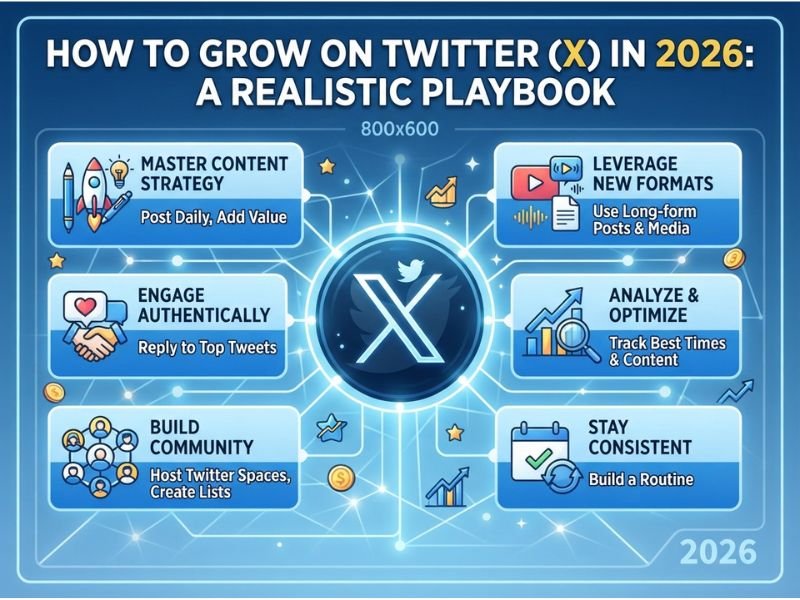
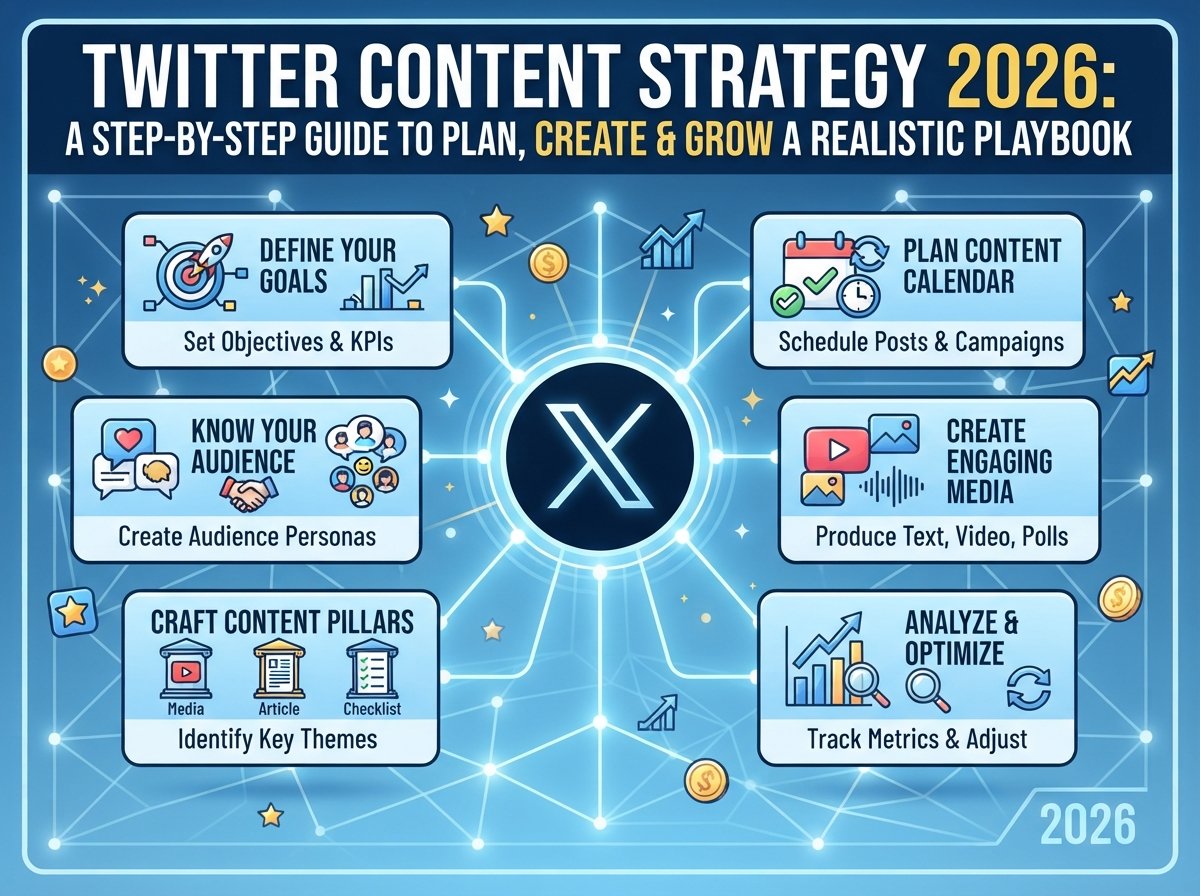
A Twitter content strategy becomes very important in 2026 because random tweeting cannot bring any benefit when working on an audience in the new year. X remains one of the fastest platforms to interact, discuss, share news, trade ideas, make videos, and build communities. The primary misconception of many influencers and brands is mistaking content with promotion itself. A proper content strategy relies on the type of content that you produce, its target audience, timing, and engagement opportunities. If you wonder how to develop a Twitter content strategy, the best approach would be developing a system rather than looking for viral ideas daily. X now offers several different types of content experience from videos, long form posts, Articles, Spaces, to Communities. Influencers have more communication opportunities now. In this guide, we will cover all aspects of a proper Twitter content strategy from start to finish. You will learn how to pick the right content pillars, formats, schedule your content, develop an identifiable voice, and boost performance. This guide will offer you more than just random tips on Twitter posting. It will offer you a system to work with.
What Is a Twitter (X) Content Strategy?
Twitter content strategy is a written document that describes what you are going to post, how frequently you are going to post, who your content is targeted at, and what outcomes you expect to see. In contrast to the whole Twitter marketing strategy, the content strategy concentrates on your published content exclusively. It doesn’t try to include everything about advertisements, customer support, paid promotions, or direct messaging. The strategy should help you answer questions like:
- What topics are we going to be discussing on a regular basis?
- What content types should we employ?
- What frequency should we publish at?
- What tone should we use?
- How will we define our success?
Simple summary: content strategy = pillars + types + schedule + tone. Once these four elements are working together, your Twitter content strategy becomes much easier to implement.
Why Twitter Content Strategy Matters in 2026
By having a well-planned strategy for your Twitter content, you are able to stand out on a platform where users can transition between breaking news, industry views, video content, memes, and more in mere minutes. It is therefore important to ensure consistency in the kind of content you post through your profile. There is also an increased scope for content publishing on the X platform, compared to the standard short post. This is because subscribers have more opportunities to post longer content, share longer videos, use Communities, and even participate in discussions through Spaces. Popularity, interaction with the post, reposting, replying, keywords, and other aspects can influence which posts will be displayed as relevant “Top” results on X. The following tips for Twitter posting will therefore ensure that you focus on the quality and relevance of your content. Having a good Twitter marketing plan may help in achieving your business goals, but it is your content that will get people interested in your account.
Step 1: Set Clear Content Goals
Determine your objectives before even considering Twitter posting. Different objectives call for different approaches in content. Some of them are:
- Branding: Expand reach & raise awareness.
- Follower building: Provide proper content for proper followers.
- Traffic driving: Drive relevant users to your content/products.
- Lead generation: Create an interest which will result in future clients.
- Community building: Create interactions, debates and connections.
- Thought leadership: Spread knowledge and valuable industry information.
- Customer service: Provide answers on frequently asked questions.
So, while a thought leader would be publishing educational tweets and expert opinions, a traffic generator would direct users to useful how-tos in his posts. Any advice about Twitter posting is based on a particular objective. Once it’s determined, selecting content pillars becomes easy.
Step 2: Audit Your Account and Study Competitors
Before building anything, take a look at what is already there. For your account audit, look for:
- Top-performing posts
- Worst-performing posts
- Current posting frequency
- Follower growth
- Average engagement
- Posts that spark conversations
- Most viewed formats
- Find patterns in what you see and don’t focus on separate posts.
For instance, you might find out that your short opinion posts are viewed while your educational posts bring saves and profile views. Then, analyze three to five successful accounts in your niche. Don’t emulate them. Look at:
- Their content pillars
- Posting frequency
- Most viewed formats
- How they initiate conversations
- Topics that work the best
Native X Analytics will help you perform an account audit while other tools will help you track content more efficiently. This analysis will help you improve your content strategy, not transform your account into the clone of another. Also, you can link this process to your overall Twitter marketing strategy and look for topics and formats that would help you achieve business goals.
Step 3: Define Your Content Pillars
Content pillars consist of three to five major themes that will drive everything you write about. These pillars help avoid the mistake of just writing down whatever comes to your mind. The following are some examples of pillars for a B2B SaaS company:
- Educational tips
- Industry news & opinions
- Behind-the-scenes details
- Customer stories
- Product releases
Posts do not importantly have to fit into one specific category all the time. Nevertheless, your overall content needs to reflect the major themes. Twitter posting tips suggest that the pillar strategy can be utilized for making sure your followers get to know what kind of value they should expect from your account. The pillars need to align with your goals. When your goal is thought leadership, educational and opinionated posts will deserve more attention. Community-building efforts will require you to focus on discussion-related posts and other pillars. Choosing fewer themes is among the best Twitter posting tips.
Step 4: Choose the Right Twitter Content Formats
This is where the strategy of your Twitter content comes into practice. There are various types that suit various purposes, and using a balanced combination will make sure that your profile stays intriguing while maintaining consistency.
1. Single Text Post
A single text post will suit the following:
- Opinions
- Reactions
- Hot takes
- Lessons
- Questions
This kind of post is easy to digest and helps you join real-time discussions.
2. Threads
Threads may prove useful when more information is needed on a particular subject. Threads may include:
- Handbooks
- Narratives
- Instructions
- Industrial reviews
- Guides
Threads can turn complex information into digestible form.
3. Images and Infographics
Images can be particularly effective when dealing with data, quotations, processes, and products. Rather than writing explanations for all of the statistics in text form, you can create an easy-to-understand image instead. Add descriptive alt text to your images so readers using assistive technology can understand them.
4. Native Video and Short Clips
Video is an essential consideration when creating content strategies for X. This social network allows for native video posts, live videos, and longer uploads for selected Premium members. Create videos for:
- Instructional materials
- Product demonstrations
- Advice from founders
- Educational videos
- Exclusive content
5. Polls
Polls will serve the dual purpose of engagement and audience research. Raise questions to gain insights about your audience instead of asking random questions in an attempt to engage.
6. Spaces
Spaces allow live discussions, interviews, discussions in the industry, and community building. They are particularly useful for brands building their authority on a particular topic.
7. Repurposed Content
Content repurposing techniques can help you save a lot of time. Here’s how:
- Re-purpose a blog post as a thread.
- Re-purpose a podcast as five blog posts.
- Re-purpose research as an infographic.
- Re-purpose a webinar as video clips.
- It doesn’t take much effort to create all content ideas from scratch.
This is also useful in terms of your overall Twitter marketing since the same content idea can work for different types of content.
Step 5: Build a Content Calendar and Posting Cadence
The content calendar helps make ideas a regular publishing system. First, schedule your content 1 week in advance or 1 month in advance. Your calendar might include the following elements:
- Topic
- Content pillar
- Format
- Date of publication
- Objective
- CTA
It is not necessary to post 15 times daily to be successful. High frequency publishing is logical for those who have enough resources, solid content systems, and real reason for participating in constant discussions. Many content creators and companies will find it better to begin with one or several valuable posts daily. According to a research done by Sprout Social for the year 2026, the most suitable time to engage on X was between 12 o’clock to 6 pm on Tuesdays, Wednesdays, and Thursdays, in the target audience’s local time zone. Treat these findings as a starting point and test them against your own audience’s results. Implement the above X posting tips to begin with. In addition, batching is useful. Prepare several posts at once, prepare the visuals, and schedule your calendar in advance. Twitter posting strategy planning in advance saves you time as you do not have to ask, “What should I post today?”
Step 6: Nail Your Brand Voice
Your voice needs to be identifiable. X lets companies have a more casual and straightforward voice than sites like LinkedIn. But being casual doesn’t mean that you can be inconsistent. For instance, an educational software company can opt for a voice that is:
- Clear
- Helpful
- Smart
- A bit casual
An energy product may be playful and energetic. Write a one-page guide on your voice and include:
- Words that you frequently use
- Tone you want to keep
- Areas that are off limits
- Joke boundaries
- Writing style
Consistency in your voice helps your Twitter content marketing strategy seem more human. It will also boost your Twitter marketing personality since the followers start recognizing your voice.
Step 7: Use Hashtags and Trends the Right Way
Hashtags need to provide understanding of your message, not drown it out. Do not include many hashtags unrelated to your message in every single tweet. Use:
- Relevant niche hashtags
- Community hashtags
- Trending hashtags on occasions if really relevant
Always make sure before participating in a trend that it matters to your target audience. Participation in a trend must benefit your Twitter posting strategies. This holds true for conversations, as well. You do not need to have your opinion on every single thing going on in the Internet. One of the most useful Twitter posting tips is that relevance wins forced visibility.
Step 8: Engage, Don’t Just Broadcast
Posting content is just one part of the job. The best accounts actually join in the conversation. You should:
- Answer comments in a timely fashion
- Answer mentions
- Interact with your target audience’s posts
- Share positive community content
- Post-quote interesting conversations
- Ask engaging questions
- Use polls to get opinions
X is made up of conversations; hence, your Twitter content marketing strategy needs to factor in engagement. Do not use all your effort in creating new content and ignore those people that are already interacting with you. Twitter marketing becomes relational marketing here as well. Engagements may help transform your passive followers to an engaged community. Remember: Broadcasting provides visibility; however, conversations create loyalty.
Step 9: Measure What Matters and Refine
Your strategy cannot be one-time only. Check your performance periodically. Metrics to use vary based on the objectives you set out.
For Brand Awareness
Monitor:
- Impressions
- Reach
- Profile visits
- Following increase
For Website Traffic
Monitor:
- Link clicks
- CTR
- Website visits
For Community Building
- Replies
- Reposts
- Quote posts
- Poll participation
For Thought Leadership
Metric:
- Saves/Bookmarks
- Engaging replies
- Sharing
- Profile visits
Check these metrics on a monthly basis. Questions to ask during your review:
- Which pillar worked well?
- Which form of content led to the most engagement?
- Which topic was a dud?
- What should we experiment with next?
The cycle of successful Twitter content strategy looks like this: Plan -> Post -> Engage -> Analyze -> Improve This is how data-based Twitter post suggestions trump any kind of generic advice. Your Twitter marketing strategy will definitely be more effective if you keep learning from real data.
Common Twitter Content Strategy Mistakes to Avoid
Good ideas do not necessarily lead to success where the underlying system is weak. Here are some of the common errors that you should avoid making:
- Sharing without pillars: Your profile becomes inconsistent and disorganized.
- Copying competitors: Learn from your competitors but not from their personalities.
- Ignoring engagement: It should be included in your content strategy.
- Not checking analytics: Improvement is impossible without measurement.
- Abusing hashtags: Quality should take precedence over quantity.
- Posting only promotional content: Give them a good reason for following.
- Starting each post from scratch: Content repurposing techniques can help you save time.
Twitter content strategy should involve a proper balance of planning and flexibility.
Frequently Asked Questions
Q1. What is a Twitter content strategy?
A1. A Twitter content strategy defines your audience, goals, content topics, formats, posting schedule, and brand voice. It also explains how you will measure results and improve your approach.
Q2. How do I create a Twitter content strategy?
A2. Set a clear goal, audit your account, and choose three to five content pillars. Select suitable formats, build a manageable calendar, make time for conversations, and review your results regularly.
Q3. How often should I post on Twitter or X?
A3. There is no ideal frequency for every account. Start with a schedule you can maintain, such as one useful post a day, and adjust based on audience response and your capacity to create quality content.
Q4. What content pillars should I use for Twitter?
A4. Choose themes that connect your expertise with your audience’s needs. Examples include educational tips, industry opinions, customer stories, behind-the-scenes updates, and product news.
Q5. What should a Twitter content calendar include?
A5. Include the topic, content pillar, format, publication date, objective, and call to action for each post. Leave room to join timely conversations and respond to audience questions.
Q6. How do I measure a Twitter content strategy?
A6. Match your metrics to your goals. Review impressions and follower growth for awareness, link clicks and website visits for traffic, and replies or reposts for community engagement. Use the metrics available to your account and compare similar time periods.
Conclusion: Build a System, Not Random Posts
The formula for an effective Twitter content strategy in 2026 can be summarized as follows: creating a sustainable system is key. Select the pillars for yourself, choose the formats suitable for you, create a content calendar, speak the same language, and interact with your audience. However, there is no need to emulate all successful accounts and blindly follow the trends. Just make sure that you develop content that will be valuable for your particular audience. After you have developed your strategy, analyze your data and continue optimizing. To learn more about platform-specific growth techniques, check our guides on Instagram strategy, LinkedIn content strategy, and other social media growth tips on TalkSocially.