
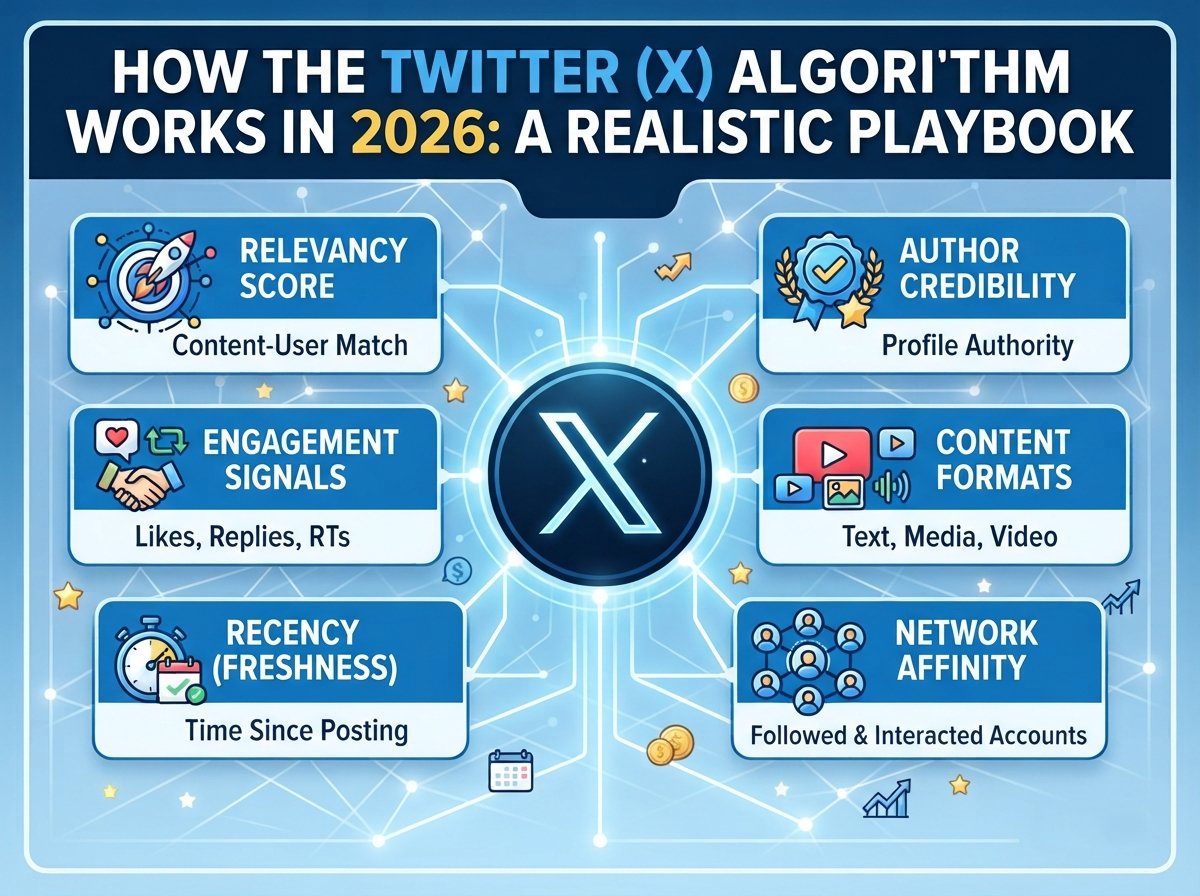
Changes in the Twitter algorithm have made the previously mentioned growth tips less reliable. At the moment, in 2026, X uses a far more advanced recommendation engine that is focused on machine learning, user actions, content comprehension, and network analysis. It should be noted that there have been some other changes related to mutual connections and original content on the platform. In order to get more Twitter reach and Twitter visibility, it is necessary to understand how exactly the ranking system works because of how it changed recently. The information provided in this article will explain everything about this system, how it was altered in 2026, ranking factors, and seven ways to improve your Twitter visibility. The information presented in this article is based on the X algorithm code and recent changes in 2026.
What Is the Twitter (X) Algorithm?
The Twitter algorithm refers to the recommendation and ranking engine that determines which posts are most pertinent to the individual in the For You feed. Rather than just publishing posts according to the time they were posted, X ranks the posts in accordance with the user’s interests, interactions, followed accounts, among others. In the current system, the Grok-based transformer model is used for recommendation, and it blends content from the followed accounts along with the posts found outside the network. According to the X source code, a pipeline is available through which candidates can be retrieved and scored to make the final feed. The For You feed is personalized as well as ranked using the algorithm. The Following feed revolves around the posts made by the followed accounts.
How the Twitter Algorithm Works, Step by Step
It is simpler to understand the Twitter algorithm if one looks at it in terms of a pipeline instead of a mysterious equation.
1. Candidate Retrieval
The first step is for X to retrieve posts that have the potential to be included in your feed. The public architecture of the platform recognizes two main sources of this content: in-network and out-of-network, where the latter is retrieved using machine learning. The algorithm is also capable of retrieving content based on topics and recommendations, which is why you can find posts from people you have never followed in your For You section. Past behavior is also taken into consideration, as likes, comments, reposts, follows, views, etc. are used to predict your interests.
2. Ranking With Machine Learning
Once the posts have been gathered, the system tries to gauge your probability of interacting with any of these posts. As explained in the public X code, there is a transformer built on Grok that provides predictions for probabilities associated with various interactions, instead of viewing all interactions the same way. The ranking process then uses these predictions to generate a score and order the candidates. It is essential for content creators since their posts do not require many likes to be seen as relevant. Various interactions could give out different information regarding relevance.
3. Filtering
Prior to the content making it to the final feed, X uses filters and Twitter visibility criteria. The platforms have systems that can take into consideration such issues as content suitability, duplicate content, safety flags, blocked or muted accounts, etc. In the current public registry, there are systems devoted to filtering and enforcement. It is important to understand that having engagement does not mean that the content will necessarily get distributed.
4. Mixing and Delivery
Lastly, the system picks the feed. X’s Home Mixer is responsible for the orchestration, which involves choosing the sources, filtering, scoring, selection, and other parts of the feed. Advertising and recommendations could also become a part of the experience. In short: Retrieval → Ranking → Filtering → Selection → Delivery This is the reason why two users of X opening it simultaneously can view completely different posts.
What Changed in the Twitter Algorithm in 2026?
The major reason why past guidance may be incorrect is that X’s recommendation stack continues to advance throughout 2026.
xAI Open-Sources New Recommendation Stack
Sources for the For You recommendation system are included within the X’s publicly available algorithm repository; this includes Thunder, Phoenix, Home Mixer, Candidate Pipeline, and Grox. The For You recommendation system employs a transformer model borrowed from Grok. The repository’s August 13, 2026 update added configuration parameters, visibility-filtering systems, and Phoenix training code. Its August 14 notes clarified that ranking weights apply to predicted actions, not raw engagement counts. It becomes clear that the recommendation system of 2026 is much more transparent than the previous one, even though all production-related details remain confidential.
Relationships and Personalized Recommendations
X’s recommendations consider interactions and network signals. For creators, building useful conversations within a relevant niche is a practical strategy, but no relationship signal guarantees additional reach.
Creator Rewards Now Favor Original Content
The monetization incentives for the creators of X have been altered by X. Since August 7, 2026, X stopped taking new signups for Creator Revenue Sharing and launched their Original Content Rewards program. This is a program based on the idea that the content created by the creator must be original and could include reporting, analysis, videos, images, graphics, and commentary. Posted copies, lightly edited content, aggregation of content with no added value, and reposting someone else’s content from other platforms may not qualify. Reposting your own original work is not automatically excluded. It does not imply that any original posts posted will be widely distributed. However, the incentive is there to encourage the creation of useful content.
Key Ranking Factors That Influence the Twitter Algorithm
The presence of one signal alone cannot ensure distribution. The algorithm takes into account several predictions and contextual signals; therefore, content producers need to focus on the quality of the interaction overall.
| Ranking factor | Why it matters |
| Recency | There are opportunities for new posts to join existing discussions. |
| Engagement | Likes, comments, retweets, shares, and many more interactions can show interest. |
| Dwell time | Putting effort into content engagement can serve as a signal of relevance. |
| Rich media | Media content like images and video can aid in making content consumable and interactable. |
| Mutual relationships | Interactions and network signals can contribute to personalized recommendations. |
| Network proximity | Content from related accounts and topics can be brought into the recommendations. |
| Negative feedback | Mute, block, report, and “Not interested” interactions can go against future recommendations. |
| Content quality | Content that is original and useful carries weight under the X Creator policies. |
How often you post is important; however, spamming your timeline should not be the objective. Ten poor-quality posts are not as valuable as two well-written posts that spark some discussion. The effectiveness of your Twitter reach on Twitter will depend more on taking meaningful actions rather than engaging.
How to Reset the Twitter Algorithm
Sometimes the feed is crowded with subjects that no longer interest you. However, there are ways to change your recommendations actively. First of all, use the “Not interested” button when X recommends some irrelevant posts. Remember never to interact with posts you do not need to see anymore because it may teach the system that you are interested in such topics. Another way is to change the view temporarily and switch to the following feed. Start following only accounts that always post content on the subject you are really interested in and react to them. Also, for better Twitter visibility, you should take into account your own activity. When you interact with irrelevant viral content all the time, your recommendations may be wider than your profession. Do not expect immediate results and give the system enough time to get used to new preferences.
Do Hashtags Still Work on X in 2026?
Hashtags are not pointless; however, there is no need to consider them the automatic growth button anymore. Today’s recommendation algorithm is capable of analyzing content, themes, and interests of users through machine learning much better. This makes it unlikely that a post filled with hashtags will give any Twitter reach by itself. Employ hashtags when they actually help to understand and explore a particular theme, especially when talking about an event, sector talk, conference, etc. Two right hash-tags may mean much more than the list of random ones. Your main goal is to write clearly, provide keywords, context and engage in a discussion, not to use many hash-tags.
7 Strategies to Work With the Algorithm in 2026
1. Opt for Native Videos and Images
Native media provides something that people can consume within the boundaries of X. Choose videos, screenshots, infographics, images, or photos that would support your idea, but which do not need to be there simply because you have been told that it works well on this platform. Choose what fits your idea and not what would be expected from this platform.
2. Post Consistently
Consistency will increase the likelihood of having the members of your audience engage with your content. You should determine the times when your audience is most active. For U.S.-based audiences, study your own analytics and do not just blindly believe the “perfect times for posts” charts. Your audience may have its own specific habits.
3. Encourage Real Conversations
Answers are useful when they reflect real interest. Ask interesting questions that will allow experts to answer. Do not create fake engagement content like irrelevant questions created solely for generating comments. Interesting questions based on your field of expertise will generate better conversations and better relations with your audience in the long run.
4. Create Real Mutual Relations
Relationship building helps creators learn what their audience values. Treat it as a community strategy, rather than a guaranteed algorithm boost. Instead of following all big accounts, find respected experts in your area of expertise. Read their content and build natural relationships by answering their questions. This strategy is helpful because it increases Twitter presence thanks to the creation of your professional circle.
5. Use External Links Carefully
Do not turn every post into a sales post with an external link if you are trying to distribute something. The useful insight comes first. Give the explanation on X, and provide additional resources where necessary. You can post additional resources in replies when needed. The idea is to create enough incentive for people to pause and engage on the platform without leaving it right away.
6. Use Threads and Long-Form Content for Difficult Topics
Some topics and ideas just can’t fit into one small post. Use threads or X Articles if you want to tell a story, conduct a tutorial, analysis, or provide an opinion on any topic. Difficult topics should be broken down into understandable parts. Hook, break it down into simple ideas, and finish with some useful information.
7. Review X Analytics Every Week
The analytics will enable you to know what is truly capturing the attention of your viewers. Impressions are not an issue anymore. Analyze replies, reposts, likes, visits to your profile, followers, and many other important actions. Find common patterns. If the same theme works better for you than others in three different posts, it is valuable data. Develop more content around it while keeping your point of view fresh. For more tips about social media, take a look at TalkSocially and use their tools while creating your profile and content.
Common Twitter Algorithm Myths, Debunked
Myth 1: “Hashtags are dead.”
That is not entirely accurate. Hashtags can improve discovery and discussion within the community, but they should never be the main way you are trying to grow.
Myth 2: “The algorithm cares only about likes.”
The public system demonstrates a multiplicity of actions. It makes predictions based on multiple behaviors, rather than simply rewarding one type of engagement metric.
Myth 3: “Purchasing followers helps with distribution.”
False followers cannot establish connections or have conversations. It is better to have an audience who listens to what you say and interacts with you, although it may be a smaller one.
Myth 4: “All ranking decisions are manually curated.”
The public code demonstrates an automated recommendation pipeline including retrieval, machine learning, filtering, scoring, and selection steps. This doesn’t mean that all decisions in terms of distribution are impartial, but it does demonstrate a level of complexity far greater than a simple manual boost list.
FAQs
Q1. What is the Twitter (X) algorithm?
A1. It is the recommendation system that selects and ranks posts for your personalized For You feed. It uses predicted interactions, your activity, and other signals to help decide what to show.
Q2. What is the difference between For You and Following?
A2. For You includes ranked recommendations from accounts you follow and accounts you do not follow. Following focuses on posts from accounts you follow.
Q3. How can I reset my Twitter recommendations?
A3. Use Not interested on irrelevant recommendations, review the accounts you follow, and engage with topics you want to see. These actions can gradually reshape your feed; they do not guarantee an instant reset.
Q4. Do hashtags still help on X?
A4. Relevant hashtags can help people find posts about a topic or event. Use them when they add context, rather than filling posts with unrelated tags.
Q5. Does posting more often guarantee more reach?
A5. No. A consistent routine gives you more opportunities to learn what your audience values, but publishing more posts does not guarantee wider distribution.
Q6. Is the X algorithm open source?
A6. X publishes code for its For You recommendation system on GitHub. The repository provides useful technical detail, but it does not expose every production asset or explain every individual ranking decision.
Conclusion
In comparison to the basic chronological Twitter algorithm that many remember from years past, the 2026 Twitter algorithm is much more complex. X now utilizes both in-network and out-of-network discovery algorithms paired with machine learning algorithms that include ranking, filtering, content understanding, and personalization. If you need to improve your Twitter visibility, then you should focus on providing helpful content, engaging in helpful conversations, posting appropriate media, maintaining a regular publication schedule, and forming meaningful connections. Continue analyzing your metrics as the algorithm changes. It’s those creators who truly understand the algorithm but don’t get caught up in the hacks who will succeed.